
Today: $17
Standard Price: $27
No Tools Needed • Immediate PDF Download • 30-Day Refund

For Homeowners Facing HVAC, Insulation, Windows Or Another Big Fix
Don't Let Your
Rising Power Bill
Turn Into A
$5K—$30K Mistake
Run This 90-Minute Leak Screen Before You Approve A Costly Fix
When your home energy bill keeps climbing, a big fix can start feeling like the safe choice — even before you know if it’s right
In just 90 minutes, this kit narrows down the 1–3 zones worth checking first and puts a working diagnosis in your hand, so you don’t walk into an expensive decision blind
Today: $17
Standard Price: $27
No Tools Needed • Immediate PDF Download • 30-Day Refund


Surprisingly, the fix you may regret the most is the one that sounded reasonable. Here’s why.
The Most Expensive Home Energy Mistake Usually Starts With The Fix That “Makes Sense”
You already know something’s off with your energy bill this year.
Maybe not catastrophically wrong. Just steadily wrong. Month after month.
Higher than last season. Higher than it should be. And nothing obvious explains it.
So you do what careful homeowners do.
You adjust the thermostat. Swap the filters. Check the vents. Then wait for the next bill, hoping it'll finally land where it should.
But there it is again…
Still too high.
Still wrong.
Still not making sense.
Then the conversation changes.
Maybe a contractor comes out. Maybe a neighbor mentions what they replaced. Maybe you start comparing options yourself. Either way, the usual suspects start lining up.
HVAC.
Insulation.
Windows.
Ductwork.
A quote ends up on your table: confident, detailed, and expensive enough to make your stomach churn.

An expensive upgrade may feel like the safe choice. That doesn’t mean it’s the right fix.
Trouble is, they all sound reasonable.
Which is exactly how a preventable five-figure mistake begins.
Not because you’re careless. You’re trying to be careful.
And once a fix sounds reasonable, it starts feeling like the "safe choice" — even before you know if it matches what your home is actually showing you.
A higher bill tells you something changed. It doesn't tell you what changed. And a confident quote can sound right without being right.
Now, this isn't to say you should ignore the quote. Or dismiss the contractor. It's simpler than that:
Don't let one explanation become the whole story before serious money gets attached to it.
Watch out for this trap.
The more reasonable the fix sounds, the harder it gets to slow down and ask:
“Is this actually where my home is pointing?”
Because once a quote has momentum, the decision starts to feel smaller than it really is. And that’s when a wrong fix gets expensive.
“Thought I Needed A New HVAC… Then I Found Where All My Heat Was Going!”

One New York homeowner had the kind of winter that makes a new HVAC system start sounding reasonable.
He’d already added insulation, but his HVAC kept running, the house still didn’t feel right, and he was getting hammered with $300+ winter electric bills.
The obvious answer was sitting right there:
“My HVAC just can’t keep up anymore. So maybe I just need a new one?”
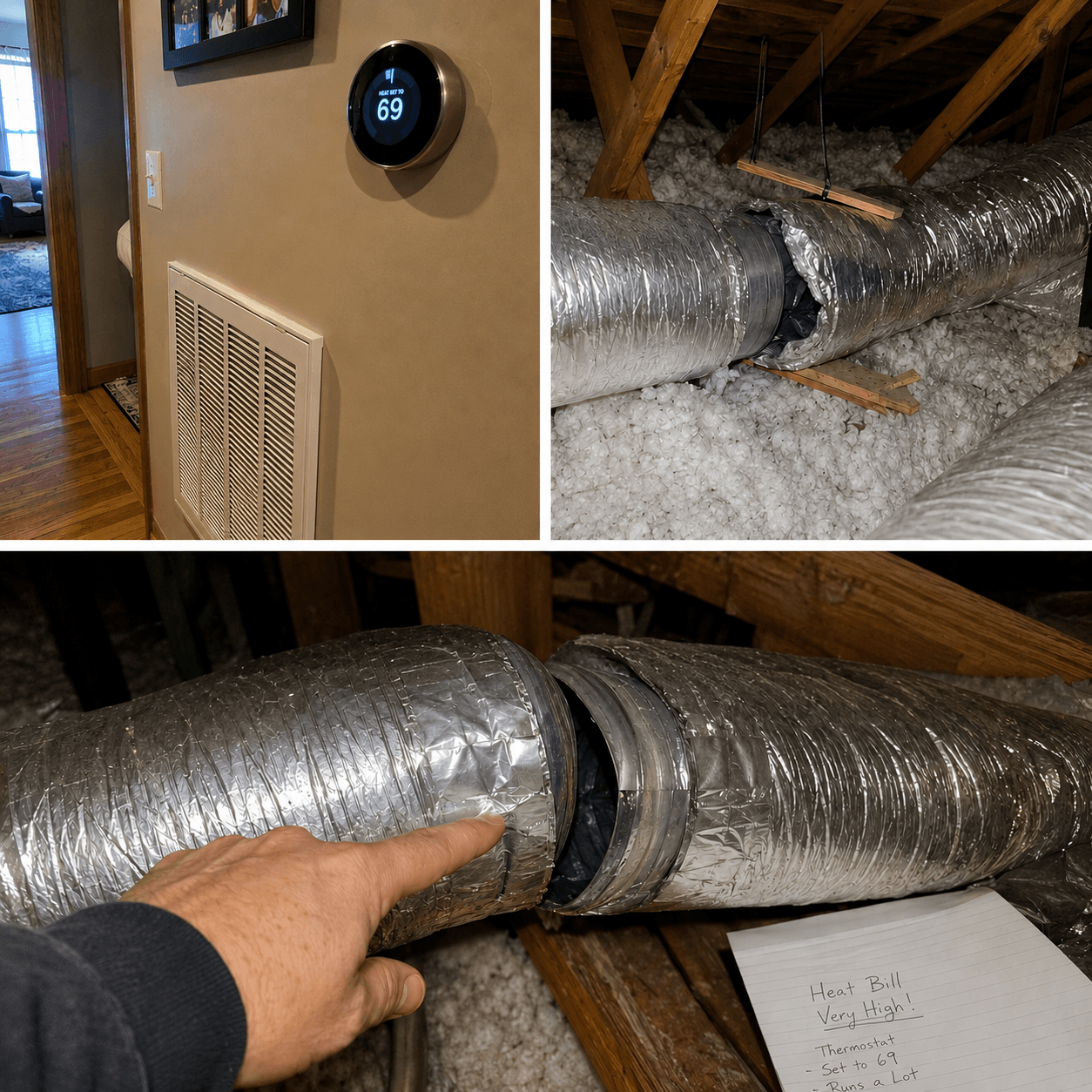
This is the kind of clue that can make a "new HVAC" decision look very different
Not so fast.
The system was making heat. But the house wasn’t getting all of it where it needed to go.
When he stopped reacting to the loudest clue and looked at the pattern, one area kept coming up: the attic.
So that’s where he started looking before giving the HVAC quote too much weight.
And that’s when the story changed.
When he checked that area, he found a broken duct seal dumping warm air into the attic all winter.
The HVAC wasn’t automatically innocent. The ductwork wasn’t automatically guilty. But the first reasonable explanation wasn’t enough to deserve the whole checkbook by itself.
That’s the point.
A loud clue can get your attention. A repeated pattern tells you where to look first.
Most people don’t get lucky and catch the real problem before money is already on the table. Most of the time, you’re left with a rising bill, a confident explanation, and a decision that suddenly feels bigger than you expected.
That’s the dangerous part.
Because once the quote is in front of you, the question changes.
It’s no longer:
“What might be causing this?”
It becomes:
“Do I approve this… or not?”
And if you don’t have your own organized read of what your home has been showing you, that decision gets harder than it should be.
There's a step that belongs between a rising bill and a big-money fix.
That’s what comes next.
The Step Careful Homeowners Take Before Spending Serious Money
A rising bill doesn't feel like a big money decision at first.
But once the conversation turns toward HVAC, windows, insulation, or ductwork — anything that runs into serious money — the situation’s changed.
Now you’re not just trying to lower a bill.
You're trying to keep one reasonable-sounding guess from turning into a $14,000 check you can't take back.
Maybe you’ve noticed this already…
Getting yet another opinion won’t solve this. Scrolling another “home energy loss” forum thread won’t either.
Because another explanation only helps if you have something of your own to measure it against.
Every outside explanation has the same weakness:
It didn’t live through the last three months in your house.
It didn’t notice which room changed first.
It didn’t hear the system run longer before the bill jumped.
And it didn’t see the small changes you almost forgot to mention.
This is how careful homeowners get boxed in:
One explanation, growing pressure to act, and nothing organized of your own to check it against.
And here’s the part that really matters.
A $14,000 wrong-fix decision doesn't just sting. It pulls money away from the things you've worked hard to protect. T
That might be family needs, repairs you already knew were coming, an emergency fund, or the nest egg you'd rather not touch.
And if the money goes to the wrong place first, the real problem in your home may still be lurking.
Only now your budget's thinner, and the next decision is harder to make.
That’s why diagnosis before spending matters.
Your bill’s a clue.
A quote’s an opinion.
And neither one should move your checkbook by itself.
What you need first is a simple way to line up your home’s signals before someone else’s recommendation starts carrying the decision.
Introducing The Home Energy Leak Detection Kit
Now You Can Run The 90-Minute Leak Screen Before A Costly Fix Starts Feeling Like Your Only Choice

Here’s where the kit comes in. It was built for one job:
To turn the signals your home has already been giving you — the rooms that feel off, the drafts you noticed, the system running longer, the bill jumping at odd times — into a working diagnosis before serious money goes toward the wrong answer.
At the center of it is The 90-Minute Home Energy Leak Screen: a step-by-step process you run at home, built around the Signal Pattern Method™.
Think of it as turning scattered home signals into a pattern you can compare against the next recommendation.
The idea is simple:
Don’t let one loud signal make the decision for your whole house.
One uncomfortable room can grab your attention. So can one draft, one long runtime, one suspicious appliance, or one contractor who sounds certain.
But attention isn’t evidence.
The Signal Pattern Method™ slows that jump down and asks a better question:
Which signals keep repeating — and which ones only feel important because they’re loud?
That distinction is often where expensive mistakes either begin or get avoided.
When you’re done, you walk away with your very own working diagnosis:
a short list of the 1–3 areas most worth checking first
a short written note on why those areas came up
a clearer sense of which weaker signals you can set aside for now
That’s important because a working diagnosis isn't the same thing as permission to spend.
This kit doesn't give you a confirmed answer. It doesn't tell you to approve a major fix. And it doesn't replace a qualified professional when one is needed.
What it does is make sure you don't walk into that conversation with only a bill, a quote, and a guess.
And once you have that short list, the next question is obvious:
Why did those areas rise to the top?
That’s what the five-phase screen is built to show.
How This Kit Helps You Catch The Wrong Conclusion Before It Gets Expensive
“One loud signal can drive a five-figure decision. A repeated pattern is harder to fool.”
That’s the idea behind the Signal Pattern Method™. Instead of letting one problem area carry the whole decision, you look at the same house five different ways and watch for what keeps showing up.
The 90-Minute Home Energy Leak Screen walks you through all five:
Phase 1: Comfort & Pattern Scan
Phase 2: Airflow & Boundary Signals
Phase 3: System Runtime & Behavior Check
Phase 4: Timing & Appliance Noise Filter
Phase 5: Priority Selection
Then, after Phase 5, you complete two short pull-out pages:
Financial Protection Pause
My Working Diagnosis
Those two pages help you pause before money moves and capture your working diagnosis in one place.
By the end, you’re not trying to make a big-money decision from memory.
You’ve run the strongest signals through the same screen, so the repeated patterns are easier to see.
One area may keep rising to the top. Another may look less important than it felt at first. A third may stay on your “watch, but don’t rush” list.
That's the difference between reacting to one signal and checking the pattern before serious money is on the line.
Here's everything you get in the kit.
What's Inside The Home Energy Leak Detection Kit
The kit gives you three core tools plus two built-in pull-out pages, all aimed at one job:
Turn scattered home signals into a working diagnosis you can use before you’re asked to approve a costly fix.
It's built to be simple to run.
You don’t need special tools. You don’t need a technical background. And you don’t need to piece together weeks of odd rooms, drafts, and bill jumps from memory.
It's delivered as a downloadable PDF kit, so you can open it right away, save it, and print the working pages you want to carry through your home.
Here’s how each piece fits into that job.
1. The 90-Minute Home Energy Leak Screen
This is the core of the kit.
It walks you through the five-step Signal Pattern Method™ in just 90 focused minutes, so you can check the right things in the right order before money starts moving.

This is the main screen that:
Spots early comfort signals — the rooms that keep feeling "off" before any single issue gets treated like proof
Checks airflow, boundaries, and system behavior without jumping straight to windows, insulation, or HVAC replacement|
Filters out the weather swings, rate changes, usage shifts, and oddball appliances that can throw the read off
Narrows your focus to the 1–3 priority zones where signals repeated most clearly across the screen
Leads into two built-in pull-out pages: one to slow the decision down, and one to keep your working diagnosis in front of you
Bottom Line: When you’re asked to approve a costly fix, you've already done the homework on your own house.
2. Signal Pattern Finder
This is the pattern map that turns scattered observations into a single signal grid where the repeats are easier to see.
You use it after the first four phases of the screen, when your observations need to leave your head and become a pattern you can actually see on one page.
Here's what it does:
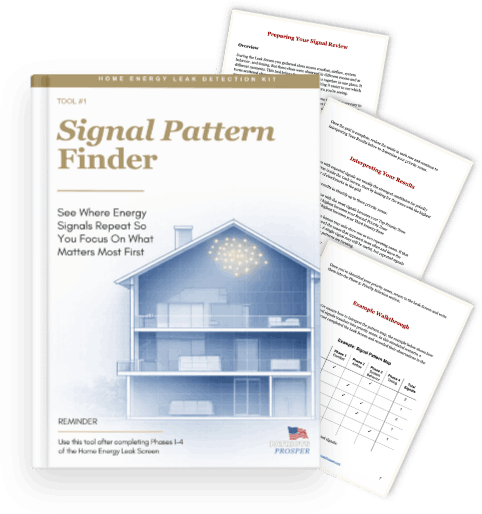
Pulls every comfort, airflow, system-behavior, and timing observation onto one grid, so the whole picture sits in front of you at once.
Shows which zones keep showing up across more than one phase — those are your repeats.
Separates the repeated signals from the one-off clues that may have felt urgent in the moment but don't deserve to run the decision.
Bottom Line: When everything stays in your head, the loudest signal usually wins. On paper, the repeats get a fair look.
3. 10-Minute Seasonal Recheck
A working diagnosis can go stale. Your house in October isn't the same house in February.
This is how you keep an earlier working diagnosis from going stale after the season changes.
So if you run the screen in October and face a bigger decision in February, you’re not relying on an old read of the house.
This is the recheck tool that:
Reexamines all five phases — comfort, airflow, system behavior, timing, and priority zones — in about 10 minutes
Flags what changed: new zones, stronger signals, or signals that disappeared
Shows whether your earlier priority zones still deserve attention, or whether you should rerun the full screen again
Bottom Line: The next big-fix conversation may not show up the same month you ran your screen. When it does, you want a working diagnosis that's still current — not one that was right last season.
Your Results, Turned Into Something You Can Use
Inside The 90-Minute Home Energy Leak Screen are two final pull-out pages that bring your results together.
They’re one page each on purpose. By the time you reach them, the screen has already done the sorting.
At that point, you don’t need more explanation.
You need the important pieces clear, tight, and easy to keep in front of you.
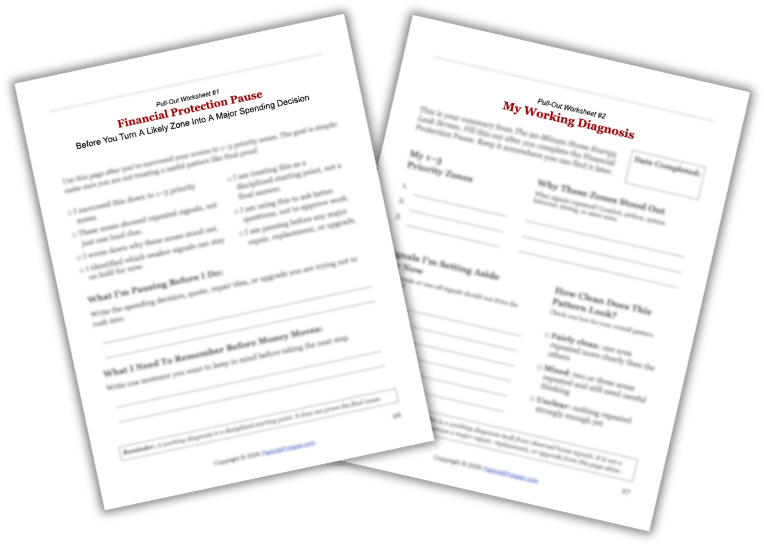
Pull-Out Page #1: Financial Protection Pause
Think of this as the brake pedal before the checkbook moves.
By now, the screen has narrowed your signals down to the 1–3 zones that deserve a closer look. That's real progress. But progress can turn into a costly assumption when you move too fast.
The Financial Protection Pause gives you a simple written checkpoint before a likely zone starts turning into a repair, replacement, or upgrade decision.
Bottom Line: A useful pattern isn't a spending decision yet. This page makes sure you don't treat it like one.
Pull-Out Page #2: My Working Diagnosis
Once the decision has slowed down, the My Working Diagnosis is the one page you keep beside the quote, so your best read of the house stays in front of you.
It pulls the most important result of your screen into one clean place, so you’re not trying to remember scattered notes when a contractor visit, sales call, or expensive home-energy decision shows up.
Instead of sitting there with only a bill, a recommendation, and a guess, you have your own working diagnosis in front of you.
Bottom Line: When the next quote shows up, you’re not relying on memory. You’ve got your own read of the house on paper.
“I'm not ‘flying blind’ anymore. I have a working diagnosis in front of me… and I'm not just hoping the contractor's right.”
The kit's built so you can finish the screen and say:
What You Actually Walk Away With After Your Screen
Picture this: the next big-fix quote is on your kitchen table.
It could be a good recommendation. It might not be. But the number's real, decision time's getting closer, and you don’t want to be figuring out your own house for the first time while someone else’s fix is already on paper.
But this time, you've got something next to that quote: your one-page My Working Diagnosis, filled out in your own hand, from your own house.
One sheet. Your 1–3 priority zones. Why each one stood out. Which weaker signals you decided to set aside. And whether the pattern looked clean, mixed, or unclear when you finished.
That changes the conversation.
You’re not sitting there quietly hoping the recommendation happens to fit.
You've got your own page to compare it against. Your own read of the house, built before the decision had momentum.
It gives you a stable place to start from.

Once you complete your kit, you'll have a clearer place to start before you need to think about serious spending.
The kind that lets you ask the question many homeowners never get to ask clearly:
“Does what you’re recommending actually match what my home showed me?”
Maybe it does.
Maybe it doesn’t.
But either way, you're not guessing from a bill anymore. You've got a working diagnosis on paper. Not a final answer, but a pattern you can actually think with.
And when that money's already got a job to do, like repairs, family, or the cushion you've been protecting, staying in control of it isn't a small thing. It's the whole reason for that 90 minutes.
Now let's pause a second to consider who this kit's actually for.
Who This Kit Is For — And Who Should Probably Pass
Here’s the honest line, so you can decide for yourself.
The Home Energy Leak Detection Kit is for homeowners who know something's off, but don’t want a big-money decision riding on one loud signal, one rising bill, or one explanation that simply sounds reasonable.
In other words, this kit is for you if:
Your power bill’s spiked, and you’re not sure what’s driving it
You suspect a major fix may be involved — HVAC, windows, insulation, or ductwork — but you want to check your home’s signals before you sign off on anything
You want to narrow your focus to the 1–3 areas most worth checking first
You want better questions in hand before the next quote or contractor visit
You don’t want one loud signal driving a five-figure decision for you
What you end up with is a completed screen, a working diagnosis, and a ranked short list of the 1–3 areas most worth checking first.
If a bigger quote or repair decision is already close, that working diagnosis gives you the starting point.
On the other hand, this probably isn't for you if:
You want instant certainty
You want someone to tell you exactly what to repair next
You want a full contractor, product, or upgrade recommendation
You want to skip the screen and jump straight to spending
This kit is for the homeowner who wants to slow the decision down, check the pattern, and avoid letting serious money follow the first explanation that sounds right.
That’s what this kit gives you: not a contractor, not certainty, but a better starting position before anyone’s price sheet is on the table.
Get The Home Energy Leak Detection Kit Today
Introductory Price: $17 (Standard Price: $27)
Run the screen before the next expensive fix gets the momentum.
Before the contractor is booked. Before the quote starts feeling like the only answer. Before the fix gets too hard to question.
The risky move here isn’t spending $17 to check the pattern.
The risky move is approving a costly fix before you know whether it matches what your home is actually showing you.
That is why the math is simple:
A small $17 investment puts a safety step in front of a possible $5,000–$30,000 decision.
If the screen helps you slow down, check the pattern, and ask better questions before serious money is committed, it’s done its job.
Because a wrong-fix decision doesn't just cost what it costs. It pulls money away from something else you were counting on — breathing room, home repairs, family plans, or the savings you'd rather leave alone.
And once that money goes to the wrong place, the real problem may still be waiting.
We’re launching the kit at $17 because we want to get it into homeowners’ hands early, before summer heat, higher bills, and bigger home-energy conversations start adding pressure.
The standard price will be $27 after this launch period.
Right now, the complete kit is available for $17.
Here’s what you get today:
The 90-Minute Home Energy Leak Screen: The core five-phase Signal Pattern Method™ screen that narrows your home's signals to the 1–3 zones most worth checking first
Signal Pattern Finder: The pattern map that turns scattered observations into one signal grid where the repeats are easier to see
10-Minute Seasonal Recheck: A quick way to keep your working diagnosis from going stale when the season changes
And to bring the screen home, you also get two pull-out pages that do the final heavy lifting:
Financial Protection Pause: The page that helps slow the decision down before a useful pattern gets treated like final proof
My Working Diagnosis: Your one-page summary from the screen, kept in front of you when the next quote, contractor visit, or major home-energy decision shows up
After checkout, you’ll get immediate access to download the PDF kit. We’ll also send a backup download link to your email.
Most homeowners find it easiest to print the full kit and write their observations by hand. So once you've downloaded it, print first, then run the screen. Use the pull-out page. Fill out your My Working Diagnosis page.
If it doesn’t help you sharpen your working diagnosis and feel better prepared for the next quote or contractor visit, email us within 30 days for a full and prompt refund.
No Tools Needed • Immediate PDF Download • 30-Day Refund
"I don’t have to write a $14,000 check on a guess. Not on this house. Not this year."
This kit's for homeowners who want to say:
And if you’re still on the fence, let’s look at what your options actually cost you.
The Two Ways You Can Handle Your Next Expensive Fix
At this point, there are two ways you can go.
Option #1: Keep Going With The Best Guess You’ve Got Right Now
Sometimes the first guess about the problem is right.
But sometimes it's not.
The check goes out. $5,000. $14,000. Maybe even $30,000.
Three months later, the bill’s still climbing. The contractor did exactly what you paid them to do. The problem is, the money was pointed at the wrong place from the start.
A check like that doesn’t come back. It’s just gone. And whatever it was supposed to protect is smaller now.
You don't just lose your hard-earned savings. You lose what that money was supposed to do: cover the next repair, protect breathing room, help family, or keep the cushion you didn't want to touch.
Option #2: Spend 90 Minutes Getting Clearer Before Bigger Money Is On The Line
Or, you can let the screen walk you through the signals first.
In about 90 focused minutes, the screen helps turn your home’s signals into a working diagnosis before you’re faced with the next costly fix.
And one page matters most here: your My Working Diagnosis. Filled out in your own hand. Your 1–3 priority zones, why each one stood out, and which weaker signals you decided to set aside.
So when a quote lands on the table, you’re not just hoping it fits.
You've got your own page to compare it against.
Maybe the recommendation matches what your screen showed. Maybe it doesn't. But either way, you've already got your own read of the house in your hand.
That is what a small investment of $17 and 90 minutes gets you:
Your completed screen, your one-page My Working Diagnosis, and the pattern behind the 1–3 areas most worth checking first. One page you keep on the table when the next big decision shows up.
Get The Home Energy Leak Detection Kit Today
No Tools Needed • Immediate PDF Download • 30-Day Refund
Here’s to being prepared before your next costly home fix.
Sincerely,

“Power Paul” Miller
Senior Editor of Home Energy & DIY
Patriots Prosper

P.S. Don’t let an expensive quote become your decision. If your bill’s already climbing and a costly fix is starting to sound reasonable, run the 90-minute screen first.
You won’t walk away with a final diagnosis or a repair plan. That’s not what this step is for. What you will walk away with is your My Working Diagnosis: one page with your 1–3 priority zones, written in your own hand, so you have something of your own to compare against the next quote.
Get the Home Energy Leak Detection Kit today for $17 during this launch period, and run the screen while the decision is still yours to shape.
P.P.S. Your purchase is covered by a 30-day money-back guarantee. Download the kit, run the screen, and use the materials. If it doesn’t sharpen your working diagnosis and help you feel better prepared for the next quote or contractor visit, email us within 30 days and we’ll refund your purchase.
No Tools Needed • Immediate PDF Download • 30-Day Refund
Frequently Asked Questions
Q: What makes the Home Energy Leak Detection Kit different from using my bill, my intuition, or a contractor’s opinion?
A bill tells you something changed, not where it's coming from. Intuition over-weights one loud clue. A contractor may give you a useful opinion. But it still helps to have your own organized read before that opinion starts steering the conversation. This screen gives you the step that comes first.
Q: What exactly do I get for $17?
The complete downloadable PDF kit: three core tools, plus two pull-out pages built into the 90-Minute Home Energy Leak Screen.
The 90-Minute Home Energy Leak Screen: The core five-phase Signal Pattern Method™ screen that narrows your home's signals to the 1–3 zones most worth checking first
Signal Pattern Finder: The pattern map that turns scattered observations into one signal grid where the repeats are easier to see
10-Minute Seasonal Recheck: A quick way to keep your working diagnosis from going stale when the season turns
Inside the 90-Minute Screen, you’ll also use two pull-out pages that bring your results together:
Financial Protection Pause: The page that helps slow the decision down before a useful pattern gets treated like final proof
My Working Diagnosis: Your one-page summary from the screen, kept in front of you when the next quote shows up
Q: What do I actually walk away with on paper?
Your completed screen, plus two filled-out pull-out pages: the Financial Protection Pause and My Working Diagnosis. We recommend printing the kit and keeping the My Working Diagnosis page somewhere easy to find, so it's there when the next quote, contractor visit, or major home-energy decision lands in front of you.
Q: Do I need special tools or technical knowledge?
No special equipment. No technical background required. If you can walk through your home and notice how rooms feel, you can use this kit.
Q: How long does it take?
The core screen is designed for 90 focused minutes. The two pull-out pages only take a few extra minutes at the end. The Seasonal Recheck takes about 10 minutes later, when conditions in your home change.
Q: Is this a final diagnosis?
No. This is a working diagnosis tool. It narrows the problem to the 1–3 most likely zones before serious money gets attached to the wrong explanation.
Q: What if I'm already getting contractor quotes or considering a major upgrade?
That’s when this matters most. The kit gives you your own working read before a quote or upgrade recommendation starts becomes the whole story. That way, you’re not relying only on the bill, the quote, or the first explanation that sounded reasonable.
Q: Should I get a professional energy audit instead?
A professional energy audit can be useful, especially if you need a deeper inspection. This kit does not replace one. What it does is give you a working read first, so you’re not walking into that conversation cold. You’ll have your own notes, your own pattern, and a clearer sense of whether the explanation you’re hearing matches what your home has been showing you.
Q: How do I get access after purchase?
You get a download link on the checkout confirmation page right after purchase. We’ll also send a backup link to your email. No portals, no accounts, and nothing is shipped.
Q: Is this kit a physical product or a digital file?
You get this kit as a single ZIP file containing the PDFs. Unzip it to open all three parts. You can read them on your computer, tablet, or phone, but we recommend printing the working pages so you can carry them through your home and write down your observations as you go.
Q: Is this covered by a money-back guarantee?
Yes. 30-day money-back guarantee. If the kit doesn’t sharpen your working diagnosis and help you feel better prepared for the next quote, contractor visit, or major home-energy decision, email us for a full refund.
Q: Is this only for certain kinds of homes?
No. Signals differ across homes and climates. The decision problem doesn't: don't spend big before the pattern's been checked.
Get The Home Energy Leak Detection Kit Today
No Tools Needed • Immediate PDF Download • 30-Day Refund
Whos Built This Kit And Why
I’m Paul Miller. Friends call me “Power Paul.” I spent years around residential electrical work and home energy problems, and I kept seeing the same pattern: a climbing bill, a quote with momentum behind it, and a five-figure decision made before the real problem was ever checked.
That’s why I built the Home Energy Leak Detection Kit. It gives careful homeowners a simple way to slow down, organize what their home is already showing them, and narrow the decision before serious money gets attached to the wrong fix.
These days, I’m Senior Editor of Home Energy & DIY at Patriots Prosper, where I write about practical ways homeowners can make smarter, lower-risk decisions around energy, repairs, and household resilience.
This site is not a part of the Facebook website or Meta Platforms, Inc. Additionally, this site is not endorsed by Facebook or Meta Platforms, Inc. in any way. Facebook is a trademark of Meta Platforms, Inc.
This site provides general information for DIY and home energy enthusiasts. It is not professional electrical advice. Always follow local laws and consult a licensed electrician for installations involving household wiring. Individual results may vary. Stories and examples are illustrative only. No specific savings, performance, or outcomes are guaranteed.